2 official configurations, three practical role kits, a creator’s Scout example and 3 conditional trait budgets. Start with a purpose, then check the gear and choices you actually have.
Role ideas to adapt to your gear and available trait choices. These are not performance rankings.
Illustrated configuration
M4: official Gunsmith example
See a complete five-attachment configuration shown in the official DMZ guide, then check your own unlocks before spending cash.
Tradeoff. A fully attached example can demand more cash than adapting a weapon you already own. The illustration does not establish an affordable starter price or a best build.
If something is missing. Use the unlocked parts you can inspect and afford; leave an unavailable slot unresolved rather than substituting an unverified attachment.
Limits and related guides
Publication example, current-build compatibility unverified. No TTK, damage ranking or current price is inferred from the image.
Consider this alternative when hostile loot is already part of your objective.
Do not add extra fights to meet an unmeasured ingredient yield.
Candidates are conditional. Check your current offers, prerequisites and remaining points; minor choices can vary and existing commitments remain locked.
Review your gear
References to check against your stash; nothing here is marked owned.
Tradeoff. Two weapons and extra supplies can make the loadout more costly to replace. Keep the second weapon optional if preserving cash matters more.
If something is missing. Use your current backpack and a familiar available weapon. A missing trait does not prevent following the ingredient checklist.
Limits and related guides
Original role advice using canonical references. Trait options are alternatives, not a promised selectable allocation; no farming rate is estimated.
Compare the recovery-after-revive option against your other actual offers.
Do not assume it can be selected with every other recovery candidate.
Candidates are conditional. Check your current offers, prerequisites and remaining points; minor choices can vary and existing commitments remain locked.
Review your gear
References to check against your stash; nothing here is marked owned.
Tradeoff. Specializing in squad recovery can be less useful on a solo run. Medical preparation competes with other uses of your materials and backpack.
If something is missing. Keep the same squad communication plan with the supplies you actually have. A trait name is not a substitute for carrying a needed item.
Limits and related guides
Original squad-role advice; no revive-time, damage, handling or combined-trait benefit is measured.
Consider the detection-related choice when limiting enemy information matters to your route.
Read its specific detection scope; do not treat it as universal invisibility.
Candidates are conditional. Check your current offers, prerequisites and remaining points; minor choices can vary and existing commitments remain locked.
Review your gear
References to check against your stash; nothing here is marked owned.
Tradeoff. Spending time on reconnaissance can delay the objective. Agree what information would actually change your route.
If something is missing. If the planned information tool is unavailable, use a simpler objective and an explicit regroup rule rather than assuming a future UAV or tower.
Limits and related guides
Original route advice. Detection ranges, full-build availability, weapon rankings and timing advantages are unmeasured.
Candidates are conditional. Check your current offers, prerequisites and remaining points; minor choices can vary and existing commitments remain locked.
Before you deploy
Watch the relevant timestamp and compare the creator's purpose with your next objective.
Record your own current offers before deciding. Minor options can differ between Operators.
Use the decision checker for a choice in your own menu; do not replace existing commitments from a video.
Tradeoff. A loot-and-information perspective may not fit a squad member assigned to recovery. The inspected segments do not establish a universal best tree.
If something is missing. If a matching option is not offered, compare the available choices against the same purpose. Do not assume the rest of the creator's tree will appear.
Limits and related guides
Creator example checked against selected public menu frames and captions. No complete 18-point build, causal effect measurement, numerical stacking or current-build reproduction is claimed.
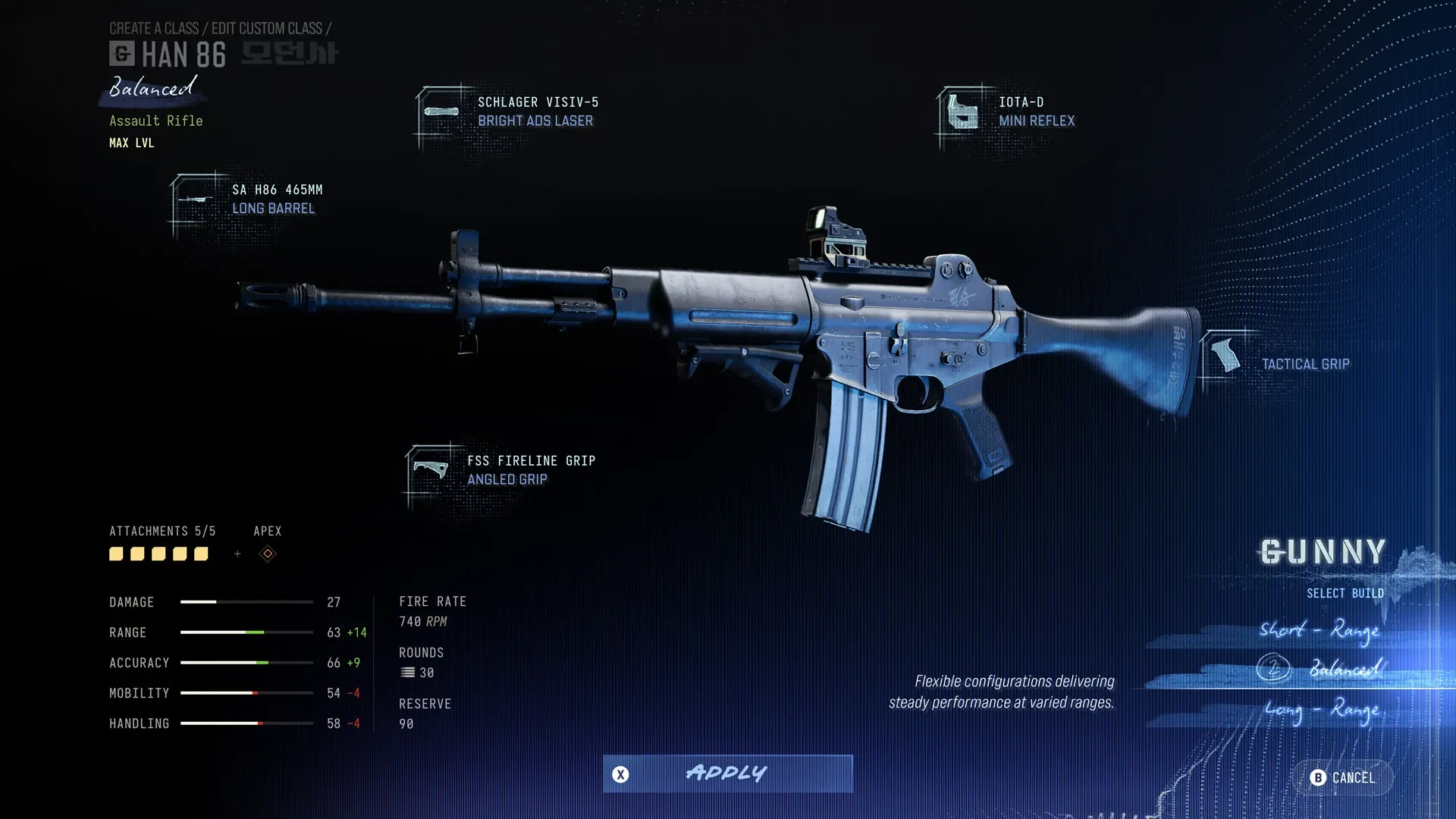
The official image identifies Han 86 and Balanced. This is a publication configuration, not a tested DMZ ranking.
Shown attachments
Han 86: official Balanced example · 2026-10-19
Slot
Attachment
Optic
IOTA-DMini Reflex
Laser
Schlager Visiv-5Bright ADS Laser
Barrel
SA H86 465mmLong Barrel
Underbarrel
FSS Fireline GripAngled Grip
Rear Grip
Tactical Grip
All five equipped labels read at full resolution. No Apex attachment is shown as selected. This Create-a-Class illustration is a reference for a system also available at the DMZ FOB.
Make it yours
Check the actual parts and price in your Gunsmith. A pictured configuration does not establish current unlocks or ownership.
Before you deploy
Compare each named slot against your Han 86 in the FOB Gunsmith.
Check your attachment unlocks, available weapon slots and cart total before purchasing.
Use the FOB Firing Range to assess the sight picture and handling; change the plan if your available configuration differs.
Tradeoff. The pictured five-slot configuration may require a different rarity or unlock state from the weapon you currently own.
If something is missing. Use Gunny with the attachments actually available to you and keep that resulting configuration separate from this example.
Limits and related guides
Official Multiplayer Create-a-Class screenshot; the article also describes Gunny in DMZ. Current-build DMZ compatibility, cost and performance are unverified. Displayed stat bars and damage numbers are not imported as combat measurements.
Put the target budget into loot decisions and getting supplies home. The plan favors a clear resource objective over optional fights.
Target budget · 18 points
Warfighter
0 of 9
Scout
9 of 9
Survivalist
9 of 9
Conditional target. 18-point arithmetic is complete; named selection legality is unresolved until the current Operator offers, prerequisites and costs are recorded.
Open Scout with an actual initial offer; inspect its next visible branch before committing more points.
Develop Scout and Survivalist toward nine choices each, one unlocked branch at a time. Alternate when the actual offers better support the next trip.
Leave Warfighter at zero only if that matches your existing commitments. Stop at 18 total points.
At each available branch, choose exactly one actual offer. Use the priorities below only when they appear; do not treat alternatives as simultaneously available. Record the choice before advancing.
Minor offers are random. Compare the actual descriptions with the job; an absent named option stays absent. A target does not reserve a roll.
Keep existing commitments. If they occupy a tree outside this distribution, recalculate the target within your remaining budget; this plan cannot move or refund points.
Use the target with your Operator
Complete 18-point target distribution across trees; named branch choices remain conditional. This is an original planning template using published rules, not a captured Operator build.
Your existing choices and actual branch offers determine what can be selected. This page does not change saved Operator state.
Consider the described Last Stand extraction behavior when it is offered.
The description does not establish a safe route or remove hostile pressure.
Candidates are conditional. Check your current offers, prerequisites and remaining points; minor choices can vary and existing commitments remain locked.
Before you deploy
Pick the recipe shortage and atlas destination first.
Review the available branch and read every offered description.
Keep extraction and carried resource recovery separate from the loot you merely saw.
Tradeoff. Two completed trees leave no normal points for Warfighter. Loot modifiers have unknown rates, so this plan cannot promise a faster farm.
If something is missing. Keep a smaller allocation matching earned points and existing commitments; choose offered utility that serves the trip rather than chasing an unavailable trait.
Limits and related guides
The source describes 18 total points, nine sequential choices per tree, random Minor offers and locked choices. The allocations and priorities here are DmzNow editorial advice. Specific branch placement, offered choices, point costs and current-build legality remain unverified; no automatic state import or respec is provided.
Budget for combat continuity and recovering teammates, with roles agreed before deployment.
Target budget · 18 points
Warfighter
9 of 9
Scout
0 of 9
Survivalist
9 of 9
Conditional target. 18-point arithmetic is complete; named selection legality is unresolved until the current Operator offers, prerequisites and costs are recorded.
Open the tree whose actual initial offer helps your assigned role.
Advance Warfighter and Survivalist sequentially, checking remaining points after every commitment.
Finish at nine choices in each only if the actual offers and prerequisites allow it; do not add Scout choices without revising the budget.
At each available branch, choose exactly one actual offer. Use the priorities below only when they appear; do not treat alternatives as simultaneously available. Record the choice before advancing.
Minor offers are random. Compare the actual descriptions with the job; an absent named option stays absent. A target does not reserve a roll.
Keep existing commitments. If they occupy a tree outside this distribution, recalculate the target within your remaining budget; this plan cannot move or refund points.
Use the target with your Operator
Complete 18-point target distribution across trees; named branch choices remain conditional. This is an original planning template using published rules, not a captured Operator build.
Your existing choices and actual branch offers determine what can be selected. This page does not change saved Operator state.
Consider it when your available branch offers revive support.
The source description does not provide effect magnitudes or durations.
Candidates are conditional. Check your current offers, prerequisites and remaining points; minor choices can vary and existing commitments remain locked.
Before you deploy
Assign who revives and who provides cover.
Compare actual offers with that role and preserve locked choices.
Review rescue cash and replacement gear before risking the Operator.
Tradeoff. The target spends no normal points in Scout, so you give up that tree’s possible loot or reconnaissance choices.
If something is missing. Use existing recovery equipment and squad coordination while the desired offers remain unavailable.
Limits and related guides
The source describes 18 total points, nine sequential choices per tree, random Minor offers and locked choices. The allocations and priorities here are DmzNow editorial advice. Specific branch placement, offered choices, point costs and current-build legality remain unverified; no automatic state import or respec is provided.
Keep room for combat, information and recovery while progressing a varied set of Orders.
Target budget · 18 points
Warfighter
6 of 9
Scout
6 of 9
Survivalist
6 of 9
Conditional target. 18-point arithmetic is complete; named selection legality is unresolved until the current Operator offers, prerequisites and costs are recorded.
Open trees as needed for actual offers supporting the next Order; opening all three is a choice, not a prerequisite for missions.
Advance one available branch at a time and track six points as the limit in each tree.
Review the next locked branch before spending the sixth point; this distribution does not reach the end of any tree.
At each available branch, choose exactly one actual offer. Use the priorities below only when they appear; do not treat alternatives as simultaneously available. Record the choice before advancing.
Minor offers are random. Compare the actual descriptions with the job; an absent named option stays absent. A target does not reserve a roll.
Keep existing commitments. If they occupy a tree outside this distribution, recalculate the target within your remaining budget; this plan cannot move or refund points.
Use the target with your Operator
Complete 18-point target distribution across trees; named branch choices remain conditional. This is an original planning template using published rules, not a captured Operator build.
Your existing choices and actual branch offers determine what can be selected. This page does not change saved Operator state.
Consider it as part of a squad recovery plan if offered.
Smoke on downing does not guarantee a safe revive.
Candidates are conditional. Check your current offers, prerequisites and remaining points; minor choices can vary and existing commitments remain locked.
Before you deploy
Open the next Order and choose equipment before allocating traits.
Compare the next available offer with your immediate objective.
Count existing choices in all three trees; keep the total within earned points.
Tradeoff. Six per tree keeps breadth but gives up the final three branches of each tree; any later named trait may be unreachable under this target.
If something is missing. Concentrate the available points in fewer trees if the actual offers better serve your next Order, then revise the allocation explicitly.
Limits and related guides
The source describes 18 total points, nine sequential choices per tree, random Minor offers and locked choices. The allocations and priorities here are DmzNow editorial advice. Specific branch placement, offered choices, point costs and current-build legality remain unverified; no automatic state import or respec is provided.